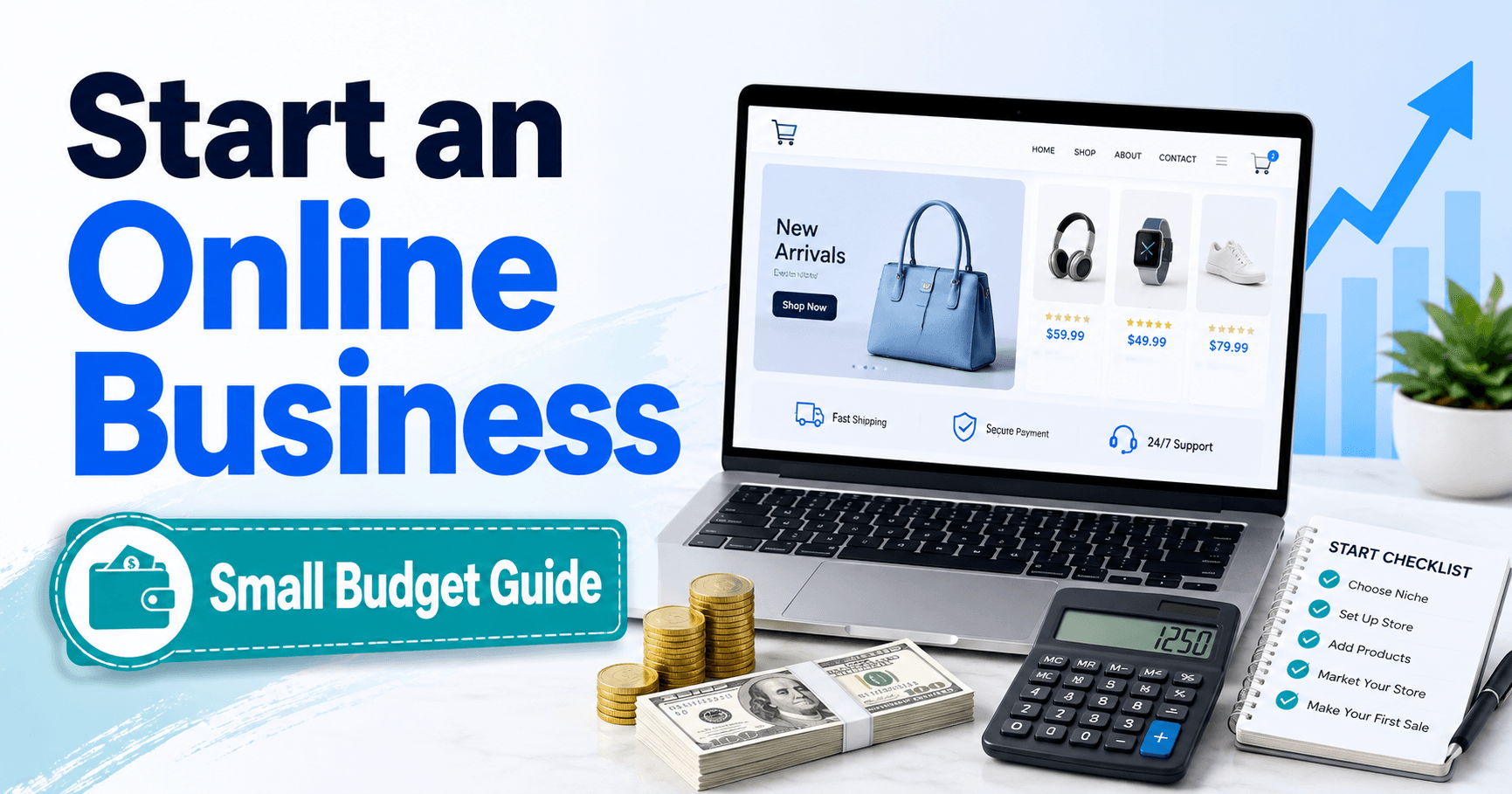
You do not need a large office, a warehouse, or thousands of dollars to start an online business.
A small-budget online business can begin with a simple website, one clear offer, a small number of tools, and a realistic plan for finding customers.
The most important goal at the beginning is not to build a perfect company. It is to prove that real customers are willing to pay for what you offer.
QUICK ANSWER
To start an online business with a small budget, choose a simple business model, solve one specific customer problem, validate demand before spending heavily, create a basic website or marketplace presence, use low-cost tools, start with organic traffic, track every expense, and reinvest early profits instead of building expensive systems before you have customers.
Can You Really Start an Online Business With a Small Budget?
Yes, but the business model matters.
Some businesses require large upfront investment in:
- Inventory
- Equipment
- Employees
- Warehousing
- Paid advertising
Others can begin with much lower fixed costs.
Examples include:
- Freelance services
- Consulting
- Digital products
- Content websites
- Affiliate marketing
- Print-on-demand
- Marketplace selling
- Small-scale ecommerce
Important:
A low startup cost does not mean the business is easy. You usually replace financial investment with time, learning, marketing effort, and consistent execution.
1. Choose a Business Model With Low Fixed Costs
Start by choosing a model that matches your budget and skills.
Low-cost options include:
- Selling a service
- Selling digital downloads
- Creating educational content
- Affiliate marketing
- Print-on-demand
- Dropshipping
- Small marketplace reselling
Service businesses are often among the cheapest to start because you are primarily selling your skill or time rather than physical inventory.
Beginner Tip:
If your budget is extremely limited, start with something you can sell before buying inventory.
2. Solve One Specific Customer Problem
Do not begin with a vague idea such as:
I want to make money online.
Instead, identify:
- Who the customer is
- What problem they have
- What result they want
- Why they would pay for help
For example:
Weak idea: Online marketing service
Stronger idea: Google Business Profile setup for local restaurants
The second offer is easier to understand, price, market, and test.
Simple rule:
The easier it is to explain who you help and what result you provide, the easier it becomes to test the business.
3. Validate Demand Before Spending Money
One of the most expensive beginner mistakes is building first and checking demand later.
Before spending heavily, look for evidence such as:
- People searching for the problem
- Existing competitors
- Active marketplace listings
- Customer questions in forums
- Reviews of competing products
- Businesses already paying for similar services
Competition is not always bad.
Existing competitors can prove that customers already spend money in the market.
Warning:
Do not spend weeks building a website, logo, and product before confirming that anyone wants the offer.
4. Start With a Simple Website or Sales Page
You do not need a complicated website on day one.
A basic business website only needs to explain:
- What you offer
- Who it is for
- What problem it solves
- How much it costs or how to request a quote
- How to contact or buy from you
If you sell through a marketplace, your first sales page may simply be the marketplace listing itself.
For service businesses, a simple landing page and contact form can be enough to begin testing demand.
Cost Tip:
Spend money on functions customers actually need before paying for premium design features they may never notice.
5. Use Free or Low-Cost Tools First
New businesses often overspend on subscriptions.
You may only need basic tools for:
- Documents
- Spreadsheets
- Design
- Website management
- Payments
- Analytics
Start with free plans where they are sufficient.
Upgrade only when the paid feature solves a real limitation.
Subscription Rule:
Every recurring tool should either save meaningful time, improve sales, or reduce risk. If it does none of those, reconsider it.
6. Get Your First Traffic Without a Large Ad Budget
Paid advertising can work, but it is risky before your offer is proven.
Low-cost traffic methods include:
- SEO content
- Short-form video
- Social media posts
- Online communities
- Direct outreach
- Email referrals
- Marketplace search traffic
The best channel depends on where your target customer already spends time.
A local business service may benefit from direct outreach.
A consumer product may work better through marketplace search or short-form video.
Traffic Tip:
Choose one or two acquisition channels first. Trying to master every platform at the same time usually slows progress.
7. Track Every Expense From Day One
A small business can lose money quietly through many small subscriptions and fees.
Track:
- Domain and hosting
- Software
- Marketplace fees
- Advertising
- Payment fees
- Inventory
- Shipping
- Refunds
A simple spreadsheet is enough at the beginning.
Track:
Revenue − Total Expenses = Net Profit
Warning:
Do not judge the business by sales revenue alone. A business can generate orders and still lose money.
8. Reinvest Early Profit Carefully
When the first profits arrive, use them to strengthen what already works.
Possible reinvestments include:
- Better product images
- Improved website hosting
- More inventory
- Testing advertising
- Better automation
- Customer-service tools
Do not immediately increase fixed expenses because of one successful month.
Wait until the business shows repeatable demand.
Recommended approach:
Prove demand first, improve the offer second, and scale spending third. This keeps a small-budget business from becoming an expensive experiment.
Example Small-Budget Startup Plan
A simple starting budget might look like:
- Domain: $10–20 per year
- Basic hosting: $5–15 per month
- Email and productivity tools: Free or low-cost plans
- Design tools: Free plan
- Advertising: $0 initially
You could begin with well under $100 if the business does not require physical inventory.
Physical-product businesses usually require additional capital for:
- Inventory
- Packaging
- Shipping
- Returns
What Should You Spend Money on First?
Prioritize expenses that directly support:
- Getting customers
- Delivering the product or service
- Receiving payments
- Building basic trust
Delay spending on:
- Expensive branding packages
- Large software stacks
- Premium office equipment
- Unproven advertising campaigns
- Complex automation
until the business proves that customers are willing to buy.
Common Small-Budget Online Business Mistakes
- Building before validating demand
- Choosing too many business models
- Buying unnecessary software
- Spending heavily on branding
- Running ads before testing the offer
- Ignoring expenses
- Trying every marketing channel
- Scaling before achieving consistent sales
Frequently Asked Questions
How much money do I need to start an online business?
It depends on the model. Service, content, and digital-product businesses can often start with very little capital, while inventory-based ecommerce usually requires more.
What is the cheapest online business to start?
Businesses based on skills or digital delivery are usually cheaper because they do not require physical inventory or shipping.
Should I pay for advertising immediately?
Usually not. Validate the offer and conversion process first unless you already have strong evidence that paid acquisition will be profitable.
Do I need a website?
Not always. Marketplace sellers may begin directly on a marketplace, while service businesses often benefit from a simple website or landing page.
When should I spend more money?
Increase spending when you have evidence that additional money will strengthen a process that already produces customers or profit.
Beginner Checklist
- ✓ Choose a low-cost business model
- ✓ Define one customer problem
- ✓ Validate real demand
- ✓ Build a simple sales presence
- ✓ Use low-cost tools
- ✓ Focus on one or two traffic channels
- ✓ Track every expense
- ✓ Reinvest only after proving demand
Bottom line:
Starting an online business with a small budget is possible when you keep fixed costs low and focus on validation. Choose one customer problem, create the simplest workable offer, find your first customers cheaply, track profit carefully, and scale only after the business begins producing repeatable results.