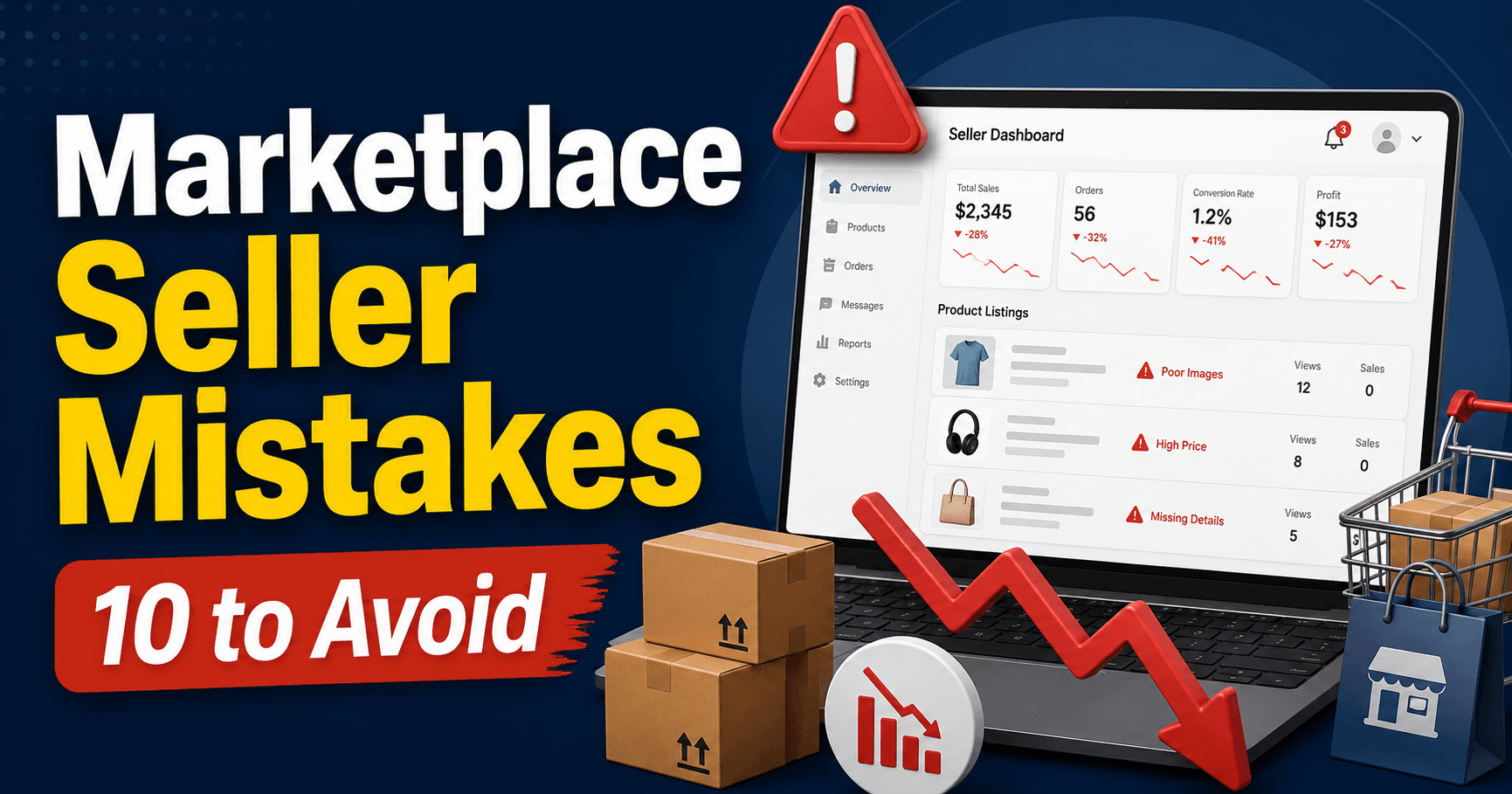
Marketplace selling can look simple from the outside: list a product, receive orders, ship the item, and collect the revenue.
In reality, many sellers lose money because of small operational mistakes that repeat across dozens or hundreds of orders.
The biggest problems are often not dramatic. They are pricing errors, weak listings, poor inventory control, late shipping, bad ad decisions, and focusing on sales instead of actual profit.
QUICK ANSWER
The most common marketplace seller mistakes are choosing products without checking demand, copying competitor prices blindly, ignoring marketplace fees, creating weak listings, using confusing product options, overspending on ads, promising unrealistic shipping times, failing to track inventory, ignoring returns, and measuring revenue instead of net profit.
Why Small Seller Mistakes Become Expensive
A single mistake may not seem serious.
But marketplaces multiply mistakes.
If you lose only $2 of unexpected margin per order and sell 500 units, the total loss becomes $1,000.
If an unclear option causes repeated returns, the damage includes:
- Refund costs
- Return shipping
- Customer-service time
- Negative reviews
- Lost inventory
Important:
Marketplace success is not only about finding winning products. Reliable pricing, listings, fulfillment, and cost control matter just as much.
1. Choosing Products Without Checking Demand
One of the first mistakes is choosing products based only on personal preference.
Before listing a product, investigate:
- Search demand
- Competitor activity
- Review volume
- Seasonality
- Typical selling price
- Number of competing sellers
A product can be excellent and still be a poor marketplace opportunity if very few customers search for it.
Seller Tip:
Separate “I like this product” from “customers are actively searching for this product.”
2. Copying Competitor Prices Blindly
The cheapest seller is not automatically the most successful seller.
Competitors may have:
- Lower supplier costs
- Different marketplace fees
- Lower shipping expenses
- Special fulfillment rates
- Different profit targets
If you copy their price without calculating your own costs, you may sell at a loss.
Your price should be based on:
Your total cost + required profit + market conditions
Warning:
Never lower a price until you know your break-even point.
3. Ignoring Marketplace Fees
Marketplace fees can significantly reduce the money you keep from each order.
Possible costs include:
- Sales commission
- Referral fees
- Payment-processing fees
- Fulfillment fees
- Storage fees
- Advertising costs
A seller may look at:
$50 Selling Price − $25 Product Cost = $25 Profit
But after fees, shipping, ads, packaging, and returns, the actual profit may be only a few dollars.
Simple rule:
Calculate net profit after every selling cost, not gross profit after product cost alone.
4. Creating Weak Product Listings
A product listing needs to help both the marketplace and the shopper understand the product.
Weak listings often have:
- Unclear titles
- Poor keywords
- Missing attributes
- Weak main images
- Incomplete descriptions
- Incorrect categories
Even a strong product may receive little traffic or poor conversion if the listing is difficult to understand.
Listing Tip:
A buyer should understand what the product is, what quantity they receive, and why they might want it within a few seconds.
5. Using Confusing Product Options
Options such as size, color, quantity, and model need to be extremely clear.
Confusing examples include:
- Different quantities under similar names
- Images that do not match the selected option
- Size information hidden in the description
- Several options with nearly identical names
Confusing options can cause:
- Wrong purchases
- Cancellations
- Returns
- Customer complaints
Warning:
Never make buyers guess what they will receive after selecting an option.
6. Spending on Ads Before Fixing the Listing
Advertising can increase impressions and clicks.
But advertising does not automatically fix:
- Bad images
- Weak pricing
- Unclear options
- Poor reviews
- Slow shipping
Before increasing ad spend, check:
- Click-through rate
- Conversion rate
- Cost per order
- Net profit after ads
If ads bring many clicks but almost no sales, increasing the budget usually makes the problem more expensive.
Advertising Tip:
Improve conversion first, then scale advertising.
7. Promising Shipping Times You Cannot Meet
Fast delivery can improve conversion, but only if the promise is realistic.
This is especially important when using:
- Dropshipping suppliers
- Third-party warehouses
- Seasonal suppliers
- Overseas fulfillment
Before setting shipping times, confirm:
- Supplier processing time
- Courier pickup schedule
- Weekend delays
- Peak-season delays
Late shipping can create complaints even when the product itself is excellent.
8. Failing to Track Inventory Accurately
Selling a product that is no longer available creates immediate operational problems.
Good inventory control should answer:
- How many units are available?
- How many are already ordered?
- When will new stock arrive?
- Is the supplier still carrying the item?
For dropshipping sellers, supplier stock should be checked regularly.
Useful clue:
If cancellations frequently happen because products are unavailable, inventory synchronization needs improvement.
9. Ignoring Returns and Refund Costs
Returns are part of ecommerce.
They become dangerous when sellers pretend they do not exist in the pricing model.
A return can create:
- Refund cost
- Return shipping
- Reshipping
- Damaged inventory
- Customer-service labor
Track return rate by product.
If one product has a significantly higher return rate than the rest, investigate:
- Product quality
- Listing accuracy
- Size information
- Packaging
- Shipping damage
Warning:
A high-revenue product can still be a bad product if returns consume most of the margin.
10. Focusing on Revenue Instead of Net Profit
This is one of the most damaging seller mistakes.
A marketplace dashboard may show:
$10,000 in sales
But that does not tell you how much money the business actually earned.
Subtract:
- Product costs
- Marketplace fees
- Shipping
- Packaging
- Advertising
- Returns
- Operational expenses
The number left is much closer to the real business result.
Recommended approach:
Track net profit by product and by order. Revenue tells you how much you sold. Profit tells you whether the business is working.
Sales Are Growing but Profit Is Falling
This situation is more common than many new sellers expect.
Possible reasons include:
- Advertising cost increased
- Supplier cost increased
- Shipping became more expensive
- Discounts became too aggressive
- Return rate increased
If revenue rises but profit falls, do not automatically try to sell even more.
Fix the margin first.
Common Marketplace Seller Checklist
- ✓ Check product demand
- ✓ Calculate your own profitable price
- ✓ Include all marketplace costs
- ✓ Build clear product listings
- ✓ Make product options easy to understand
- ✓ Optimize before increasing ad spend
- ✓ Set realistic shipping promises
- ✓ Keep inventory accurate
- ✓ Track return costs
- ✓ Measure net profit, not revenue alone
Frequently Asked Questions
What is the biggest mistake new marketplace sellers make?
One of the biggest is focusing on revenue while ignoring the full cost of generating and fulfilling each order.
Should I always match competitor prices?
No. Your selling price needs to work with your own costs and target margin.
Why do my ads get clicks but no sales?
The listing, offer, price, images, reviews, or shipping may not be convincing enough to convert the traffic.
Why are returns hurting my profit?
Returns create costs beyond the refund itself, including shipping, damaged inventory, and customer-service time.
Should beginners list many products?
Not necessarily. A small number of well-researched products is often easier to manage while learning marketplace operations.
Bottom line:
Marketplace sellers usually fail from a combination of small mistakes rather than one dramatic problem. Research demand, calculate real profit, create clear listings, manage inventory and shipping carefully, control advertising, track returns, and judge every product by net profit instead of sales alone.