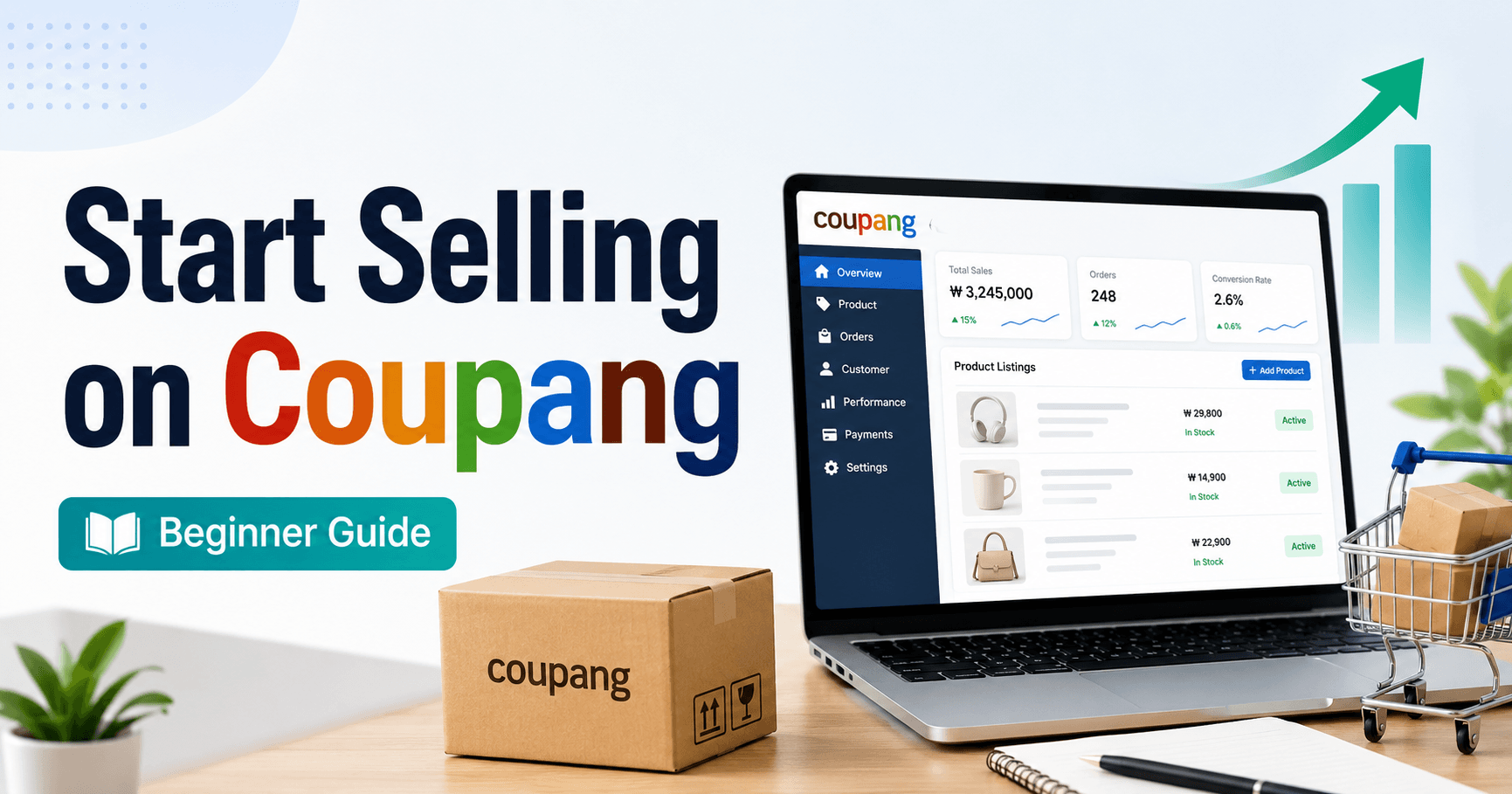
If you want to start an online selling business in Korea, Coupang Marketplace is one of the first platforms worth understanding.
For a beginner, the process can look complicated at first: business registration, seller verification, product listings, shipping, pricing, fees, and order management all need to be set up correctly.
The good news is that the basic process is much simpler when you follow it in the right order.
QUICK ANSWER
To start selling on Coupang, create a seller account, prepare your business documents, complete seller verification, access Coupang WING, choose products with enough margin, create accurate listings, set shipping and return policies, calculate all selling costs before pricing, publish your products, and monitor orders and performance after launch.
What Is Coupang Marketplace?
Coupang Marketplace allows independent sellers to list products and sell them to customers through Coupang.
Sellers use a management system called Coupang WING.
Inside WING, sellers can manage areas such as:
- Product listings
- Prices
- Inventory
- Orders
- Shipping
- Returns
- Settlement information
You do not need hundreds of products to get started. Coupang’s seller information states that sellers can begin even with a single product.
Beginner Tip:
Do not start by uploading dozens of random products. It is usually easier to learn the system with a small number of carefully selected products first.
1. Decide What You Are Going to Sell
Your first decision should not be the seller account.
It should be the product.
Before listing anything, research:
- Current selling prices
- Number of competing sellers
- Shipping costs
- Supplier cost
- Expected marketplace fees
- Return and refund risk
- Seasonality
A product with strong sales does not automatically mean it will be profitable for you.
If the competition is already forcing prices below your break-even point, high demand will not solve the problem.
Simple rule:
Calculate profit before you buy inventory or publish the listing.
2. Prepare Your Seller Documents
The documents you need depend on where your business is registered.
For a Korea-Based Seller
Coupang currently lists documents such as:
- Business registration certificate
- E-commerce business registration certificate
- Bank account copy for the representative or business
- Additional documents when required
Korean sellers may also need a purchase-safety service confirmation when completing the e-commerce business registration process.
For an International Seller
Coupang’s global seller program uses a different verification process.
Typical requirements include:
- Business license
- Government-issued identification
- Bank statement
- Proof of business ownership
- KYC verification
Important:
Do not assume Korean and overseas seller requirements are identical. Follow the onboarding process that matches the country where your business is registered.
3. Create Your Coupang Seller Account
Go to Coupang Marketplace and begin the seller registration process.
For Korea-based sellers, the basic process is:
Account creation → Identity verification → Business verification → Seller approval
Make sure the information you enter matches your official documents.
Check carefully:
- Business name
- Representative name
- Business registration number
- Phone number
- Email address
- Bank information
Small differences between documents can delay seller verification.
Tip:
Prepare all documents before starting registration instead of stopping halfway through the application.
4. Learn the Coupang WING Dashboard
Once your account is ready, Coupang WING becomes the main control center for your store.
Do not immediately begin uploading products.
First locate the major sections for:
- Product registration
- Product management
- Order management
- Shipping
- Returns and cancellations
- Settlement
- Seller information
Understanding where these tools are located will save a lot of time after orders begin arriving.
Beginner Tip:
Learn the order and shipping screens before your first sale. Waiting until an order arrives is the worst time to learn how fulfillment works.
5. Calculate Your Real Selling Price
One of the biggest beginner mistakes is comparing only the supplier price with the selling price.
Your actual calculation should include:
- Product cost
- Marketplace selling fees
- Shipping cost
- Packaging cost
- Advertising cost
- Return and refund losses
- Taxes where applicable
A simple concept is:
Net Profit = Selling Price − All Selling Costs
Then calculate your profit margin:
Profit Margin = Net Profit ÷ Selling Price × 100
Warning:
A product can generate sales while still losing money. Always calculate the expected net profit before setting the final price.
6. Create Your First Product Listing
Coupang allows sellers to register products individually or through bulk-registration methods.
For a beginner, individual registration is often easier because it lets you understand every field.
Pay close attention to:
- Product title
- Category
- Brand
- Options
- Price
- Inventory
- Main image
- Detailed images
- Product information notice
- Shipping information
Your listing should accurately describe exactly what the customer will receive.
Important:
Do not use misleading product titles, incorrect options, or images that show items that are not included in the purchase.
7. Make the Main Image Easy to Understand
Your product image is one of the first things customers see.
A good marketplace image should make the product immediately understandable.
Before uploading, check:
- The product is clearly visible
- The image is sharp
- The option matches the listing
- The customer can understand the quantity
- The background does not distract from the product
Additional images can explain:
- Size
- Quantity
- Packaging
- Product features
- Usage
- Storage
Conversion Tip:
Customers should not need to read the entire description just to understand what they are buying.
8. Set Shipping, Returns, and Customer-Service Rules
Before publishing the product, make sure you understand how the order will move from purchase to delivery.
Check:
- Order processing time
- Shipping company
- Tracking-number registration
- Remote-area shipping rules
- Return address
- Cancellation process
- Exchange process
If you use a supplier or dropshipping arrangement, verify how quickly that supplier can actually ship.
Your marketplace promise should match the real fulfillment capability.
Warning:
Do not promise shipping times that your supplier cannot consistently meet. Late fulfillment can create customer complaints and damage seller performance.
9. Publish a Small Number of Products First
A beginner does not need a huge catalog on the first day.
A better approach is to begin with a small test group.
For example:
- 3–5 products
- A few clear options
- Known supplier costs
- Simple shipping
Then monitor:
- Impressions
- Clicks
- Orders
- Conversion rate
- Advertising cost
- Profit per order
This tells you what to improve before scaling the catalog.
Recommended approach:
Learn with a small catalog, fix mistakes quickly, and expand only after you understand your real profit and fulfillment process.
10. Monitor Every Order Carefully
Your work does not end when the product is published.
After launch, check WING regularly for:
- New orders
- Shipment deadlines
- Tracking numbers
- Cancellations
- Customer inquiries
- Returns
- Settlement information
For a new seller, operational mistakes can be more expensive than listing mistakes.
A missed order or late shipment affects a real customer immediately.
Marketplace vs Fulfillment Options
Coupang offers different selling and fulfillment structures.
Traditional Marketplace sellers generally manage their own inventory and fulfillment process.
Coupang also offers fulfillment-related programs where logistics can be handled differently.
Do not choose a fulfillment option only because it promises faster delivery.
Compare:
- Storage cost
- Shipping cost
- Inventory requirements
- Return handling
- Product turnover
- Expected margin
Common Coupang Beginner Mistakes
- Choosing products without margin calculations
- Copying competitor prices blindly
- Uploading too many products at once
- Using confusing product options
- Ignoring shipping deadlines
- Not checking return costs
- Spending on ads before fixing the listing
- Looking only at revenue instead of net profit
Frequently Asked Questions
Do I need hundreds of products to start selling on Coupang?
No. Coupang states that sellers can begin with even one product. For beginners, a small product selection is often easier to manage.
What is Coupang WING?
WING is Coupang’s seller-management system for product listings, pricing, orders, sales, and other seller operations.
Do Korean sellers need a business registration?
Business verification is part of the Korean seller onboarding process. Required documents can include a business registration certificate, e-commerce business registration, and bank-account documentation.
Can overseas businesses sell on Coupang?
Yes. Coupang operates a Global Marketplace program with its own KYC and business-document requirements.
What should a beginner focus on first?
Product margin, accurate listings, reliable fulfillment, and learning the WING order workflow are more important than uploading a large number of products immediately.
Beginner Checklist
- ✓ Choose a product with enough margin
- ✓ Prepare business documents
- ✓ Create the seller account
- ✓ Complete business verification
- ✓ Learn the WING dashboard
- ✓ Calculate all selling costs
- ✓ Create an accurate listing
- ✓ Confirm shipping and return procedures
- ✓ Publish a small test catalog
- ✓ Track every order and actual profit
Bottom line:
Starting on Coupang is not mainly about uploading as many products as possible. Build the seller account correctly, understand WING, calculate real profit before pricing, create accurate listings, and make sure every order can be fulfilled reliably. Once that process works consistently, then scale.