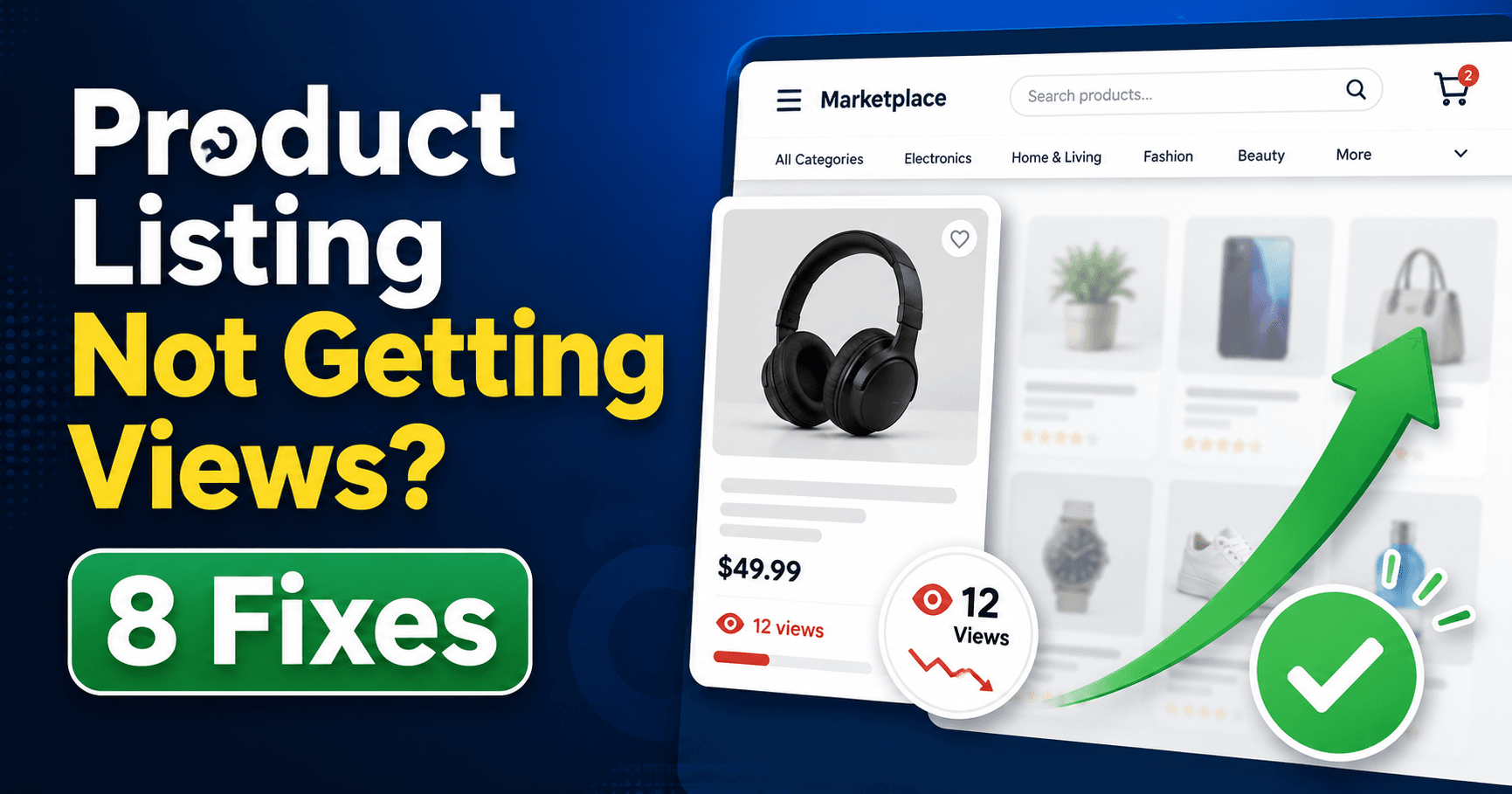
A product listing not getting views usually means shoppers are not finding your product in search results, category pages, recommendations, or ads.
The problem is often caused by weak keywords, poor category placement, an unattractive main image, uncompetitive pricing, incomplete product data, low seller performance, or simply targeting a product with very little demand.
QUICK ANSWER
To increase product listing views, improve the title and keywords, confirm the correct category, upgrade the main image, compare your price with competitors, complete every relevant product attribute, check inventory and shipping settings, use advertising carefully, and verify that real search demand exists before spending more money on promotion.
Why Is My Product Listing Getting No Views?
Marketplace traffic normally follows a simple process:
Search demand → Marketplace ranking → Listing impression → Shopper click → Product page
If your listing gets almost no views, the problem usually happens before the shopper reaches the product page.
Common reasons include:
- The product does not rank for relevant searches
- The title uses the wrong keywords
- The listing is in the wrong category
- The main image does not attract clicks
- The price looks uncompetitive
- Important product attributes are missing
- The item is out of stock or has poor shipping terms
- There is very little demand for the product
Important:
Low views and low conversion are different problems. If nobody sees the listing, fix visibility first. If many people view it but nobody buys, investigate price, trust, images, reviews, and the offer itself.
1. Rewrite the Product Title Around Real Search Terms
Your title should describe the product using words buyers actually search for.
A weak title may be:
Premium Best Quality Product
A stronger title identifies:
- Product type
- Brand when relevant
- Important size or quantity
- Key feature
- Main use case
For example:
Stainless Steel Water Bottle 1L, Insulated, Leakproof
is much more searchable than:
Premium Outdoor Bottle
SEO Tip:
Put the most important product phrase near the beginning of the title. Do not fill the title with unrelated keywords just to make it longer.
2. Confirm the Product Is in the Correct Category
Marketplace category selection affects where the product appears and which filters shoppers can use.
If the product is placed in the wrong category, it may receive very few relevant impressions.
Check:
- Primary category
- Subcategory
- Product type
- Required attributes
- Marketplace-specific classification
Compare your listing with successful competitors selling the same type of product.
If most top sellers appear under a different category, investigate whether your classification is wrong.
Warning:
Do not intentionally choose an unrelated category simply because it looks less competitive. That can reduce relevance and may violate marketplace listing rules.
3. Improve the Main Product Image
Getting an impression is not enough.
The shopper still needs to click your product.
The main image should make the product immediately understandable when shown beside competitors.
Check whether:
- The product is large enough in the frame
- The image is sharp
- The background is clean
- The product color is accurate
- The quantity is easy to understand
- The image follows marketplace rules
Search for your own product keyword and compare your main image with the first page of results.
If your image looks smaller, darker, less clear, or more confusing than competing listings, clicks may be going elsewhere.
Click-Through Tip:
A better image does not directly create search demand, but it can dramatically improve the percentage of impressions that become product-page views.
4. Compare Your Price With Real Competitors
Shoppers often see price before opening the listing.
If similar products sell for much less, your listing may receive impressions but very few clicks.
Compare products with the same:
- Quantity
- Size
- Quality level
- Brand position
- Shipping conditions
Do not compare your 2 kg package with a competitor’s 1 kg package.
Calculate the effective price per unit when necessary.
Important:
Do not lower the price below a profitable level only to gain views. Visibility without profit is not a sustainable selling strategy.
5. Complete Every Relevant Product Attribute
Marketplace search engines use more than the title.
They may also use attributes such as:
- Brand
- Color
- Material
- Size
- Quantity
- Model
- Compatibility
- Product features
These attributes can determine whether your product appears when shoppers use filters.
If important fields are blank, your listing may miss valuable filtered searches.
Simple rule:
If the marketplace provides a relevant product field, complete it accurately instead of putting all information only in the description.
6. Check Inventory and Shipping Settings
Marketplace algorithms want products that can actually be delivered.
Check that:
- The item is in stock
- Inventory quantity is correct
- The listing is active
- Shipping regions are correct
- Processing time is reasonable
- Shipping charges are competitive
Slow delivery or expensive shipping can reduce shopper interest even when the product itself is competitive.
Some marketplaces may also give more visibility to products with stronger fulfillment performance.
Warning:
Never show inventory that your supplier cannot actually fulfill. More views are useless if the resulting orders cannot be shipped reliably.
7. Use Marketplace Ads Carefully
Advertising can generate additional impressions, but it should not be used to hide a weak listing.
Before spending money, confirm:
- The main image is strong
- The price is competitive
- The product has enough margin
- The listing contains relevant keywords
- Inventory is available
Then begin with a controlled budget and monitor:
- Impressions
- Clicks
- Click-through rate
- Orders
- Conversion rate
- Advertising cost
- Return on ad spend
If ads produce impressions but almost no clicks, improve the listing before raising the budget.
Advertising Tip:
Ads can buy visibility. They cannot permanently fix a product that shoppers do not want to click or buy.
8. Verify That the Product Has Real Search Demand
Sometimes the listing is not the main problem.
The market may simply have very little demand.
Check:
- Competitor sales activity
- Review volume
- Search suggestions
- Seasonal demand
- Google Trends where relevant
- Marketplace keyword tools if available
If established competitors also receive little activity, the product itself may have weak demand.
This is especially important with:
- Highly seasonal products
- Unknown product types
- Very expensive niche products
- Products with outdated demand
Recommended approach:
Do not spend weeks optimizing a listing for a product nobody is searching for. Separate listing problems from demand problems as early as possible.
No Views vs Views but No Sales
Almost No Views
Focus on keywords, categories, search ranking, inventory, and demand.
Views but No Sales
Focus on price, product images, reviews, trust, shipping, description, and the offer.
Many Impressions but Few Views
Focus on the main image, title, price, ratings, and other information shown directly in search results.
Diagnosing the correct stage prevents you from fixing the wrong part of the funnel.
Common Reasons Product Listings Get No Views
- Weak title keywords
- Wrong category
- Poor main image
- Uncompetitive price
- Missing product attributes
- Slow or expensive shipping
- Listing not active or inventory unavailable
- Low search demand
Frequently Asked Questions
Why is my new product listing getting zero views?
New listings may need time to appear, but zero views can also mean poor keywords, incorrect category placement, inactive inventory, or little search demand.
Do product titles affect marketplace visibility?
Yes. Relevant product terms in the title help marketplaces understand what you are selling and match the listing with buyer searches.
Can changing the main image increase views?
It can improve click-through rate when your listing already receives impressions.
Should I run ads if my listing gets no views?
Only after checking the listing quality and profit margin. Advertising a weak listing can waste money quickly.
How long should I test a new listing?
There is no universal period. Track enough impressions, clicks, and sales data to distinguish a visibility problem from a conversion or demand problem.
Final Checklist
- ✓ Rewrite the title with relevant search terms
- ✓ Verify the correct category
- ✓ Improve the main image
- ✓ Compare competitor prices
- ✓ Complete all relevant product attributes
- ✓ Check stock and shipping
- ✓ Use ads only after optimizing the listing
- ✓ Confirm the product has real demand
Bottom line:
A product listing with very few views usually has a visibility, click-through, or demand problem. Fix the title, category, image, price, product data, inventory, and shipping first. Then use advertising and marketplace data to determine whether the product itself has enough demand to justify further investment.